How Formulite® works
Formulite® uses nanoporous confinement to stabilize poorly soluble drug compounds in an amorphous state, supporting accelerated dissolution and improved oral drug product performance.
From crystalline drug compound to amorphous formulation
Poorly soluble drug compounds are often present in a crystalline state, where strong molecular organization can limit dissolution in aqueous environments.
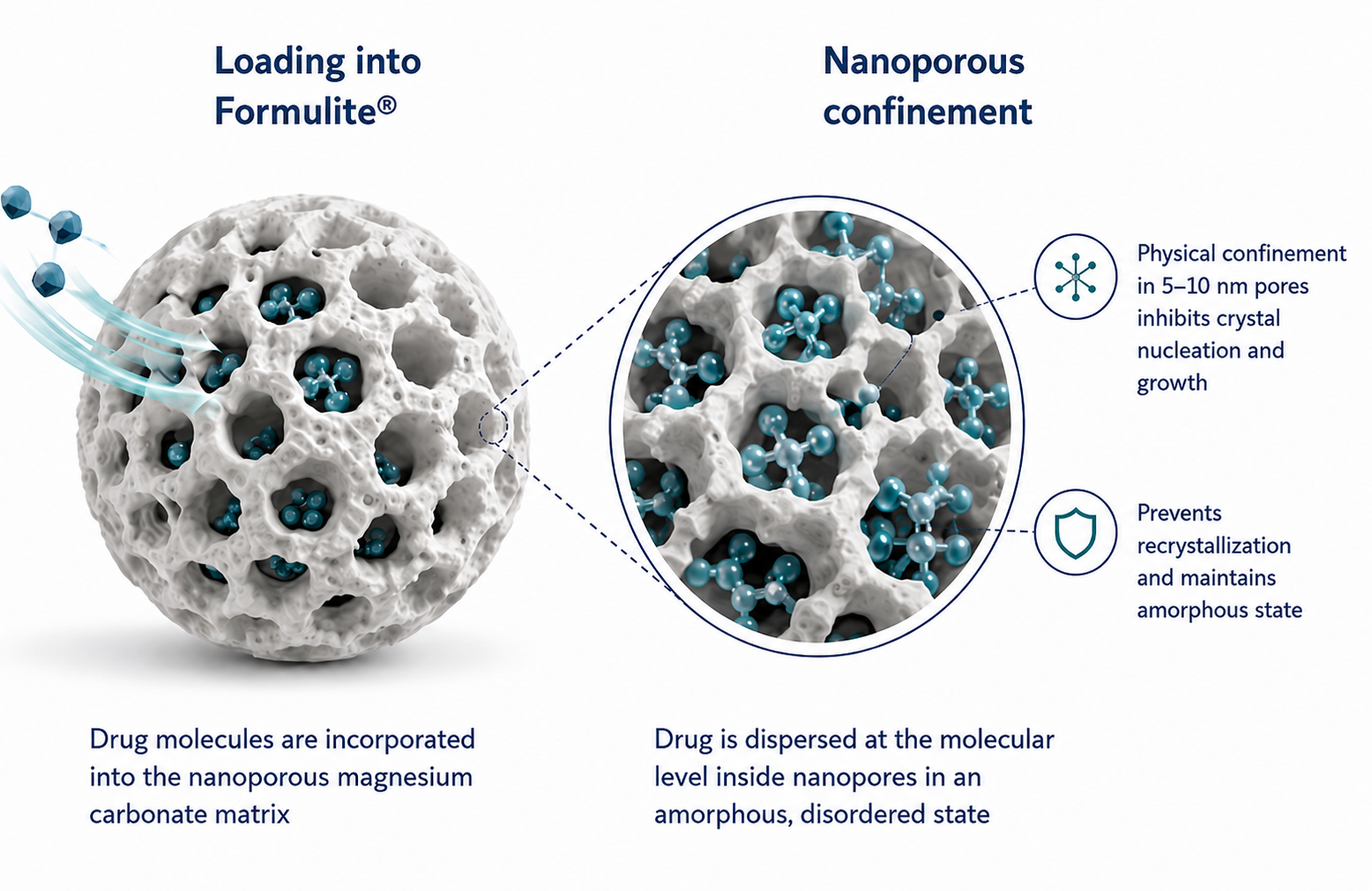
With Formulite®, the drug compound is incorporated into a mesoporous magnesium carbonate (MMC) matrix and stabilized in an amorphous state. This higher-energy form can provide improved apparent solubility and faster dissolution compared with the corresponding crystalline form.
Nanoporous confinement – the core of Formulite®
Formulite® consists of micrometer-sized particles, typically around 150 µm, containing a network of nanopores approximately 5–10 nm in width. This highly porous structure creates the confined environment that enables stabilization of drug compounds in an amorphous state.
Within these pores, spatial confinement restricts molecular mobility and inhibits crystal nucleation and growth. This helps prevent recrystallization and maintain the drug compound in its amorphous state over time.
Translating amorphous stabilization into drug product performance
Following oral administration, the Formulite® matrix dissolves in the gastrointestinal tract and releases the amorphous drug compound.
The amorphous state can generate substantially higher apparent solubility and faster dissolution than the corresponding crystalline form, supporting improved absorption and oral bioavailability. Depending on the drug compound, additional formulation components may be used to maintain supersaturation following release.
By combining amorphous stabilization with high drug loading and straightforward downstream processing, Formulite® provides a formulation platform designed not only to improve drug performance, but also to support practical oral drug product development.
A polymer-free approach to amorphous stabilization
Unlike conventional amorphous solid dispersions, which typically rely on polymer matrices to stabilize the amorphous drug, Formulite® uses nanoporous confinement as the primary stabilization mechanism.
This can reduce polymer and overall excipient burden while simplifying formulation composition. Compared with some established ASD manufacturing approaches, Formulite® can also enable lower use of organic solvents, supporting a more resource-efficient formulation and manufacturing process.
It also provides an alternative formulation approach for challenging drug compounds, including thermolabile, low-melting and poorly processable compounds, as well as compounds in the beyond Rule of Five (bRo5) chemical space.
Functional excipients can be added where needed to optimize dissolution or maintain supersaturation after drug release.
Read here how Formulite® is compatible with standard oral dosage manufacturing.